
How to Keep Humidity Out of Your Home
Moisture vapor in outdoor air is constantly trying to enter your home – especially your crawlspace. The second law of thermodynamics makes it simple:
What has heat moves toward what is cooler, and what is wet moves toward what is dry.
That means in the summertime, when outdoor air is hot and humid, it naturally drives downward into your shaded, cooler crawlspace. If you have ductwork or HVAC equipment under your home, that space is even more appealing for moisture.
Once that warm, damp air reaches the crawlspace, it hits cooler surfaces like:
-
wood framing
- electric lines
-
insulation
-
plumbing
-
Ductwork and HVAC equipment
…and immediately condenses, soaking materials and driving up humidity levels.
This is why humidity control is not a “nice to have”- it’s the foundation of a healthy crawlspace and a healthy home.
Why Crawlspace Humidity Control Matters
Uncontrolled humidity leads to:
-
mold and wood rot
-
insulation failure
-
musty odors
-
higher energy bills
-
increased pest activity
-
rusted HVAC equipment
-
poor indoor air quality
-
cupping floors and structural issues
Treating humidity properly is one of the core principles of modern building science.
Four Ways to Control Humidity in a Crawlspace

Is the Vapor Barrier really that important?
Yes! Install it once and install it right!
A true vapor barrier is more than just plastic thrown on the ground. A proper installation includes:
-
fastening to the foundation wall
-
sealing seams with approved tape
-
overlapping material correctly
-
wrapping piers
-
blocking ground moisture migration
A Class 1 vapor barrier significantly reduces humidity by stopping moisture vapor from rising through the soil.
What’s the best insulation to use?
Apply Closed Cell Spray Foam Insulation!
Closed-cell spray foam creates an air, moisture, and thermal barrier on the foundation walls. This provides:
-
sealed exterior boundary
-
reduced condensation
-
increased energy efficiency
-
more stable crawlspace temperatures
It forms a monolithic shell around the crawlspace perimeter, helping maintain an indirectly conditioned environment.


Is Ventilation the Answer?
Absolutely Not!
(Stop Letting Contractors Install These!)
With an encapsulated crawlspace, there is no reason to have any ventilation to the outside. That means all the original vents are sealed and there definitely aren’t any positive or negative pressure fans installed to intensionally connect the crawlspace with the outside.
With a sealed or encapsulated crawlspace:
-
vents are obsolete
-
vents bring in humidity
-
vents hurt energy efficiency
-
vents contribute to mold growth
Every vent should be:
-
blocked from the interior
-
sealed
-
insulated
One exception: homes located in FEMA-designated flood zones, where flood vents are required. These homes will have FEMA “Smart-Vents” installed in the foundation.
Do I Need a Dehumidifier?
Yes, you do.
Even the most energy efficient new construction home’s need dehumidifier’s. Moisture doesn’t just come from the outdoors. We produce it by breathing, cooking, showering and living within our homes.
Even with a sealed crawlspace, spray foam insulation, or an HVAC supply:
👉 You still need a dehumidifier.
(Especially in airtight modern homes.)
HVAC systems are NOT designed to dehumidify your crawlspace on their own. During spring and fall (shoulder seasons), temperatures are mild but humidity is high — meaning your HVAC won’t run long enough to pull moisture from the air.
At FLC Energy, we recommend at minimum:
AprilAire E070 for most crawlspaces on Delmarva.


Should I Heat and Cool my Crawlspace?
YES — sometimes.
If the crawlspace is designed to be conditioned, connecting it to the home’s HVAC system can further stabilize temperature and humidity.In this case, it’s certainly not a bad idea to heat and cool it! If you want to be technical, not directly supplying hot or cold air to your conditioned crawlspace means its an “indirectly conditioned” space.
It isn’t always possible to heat and cool your crawlspace though. If you have duct-work in your attic, or between your first and second floor, supplying air to this space isn’t an option. In that case, we would recommend a standard encapsulation of the space, rather than fully conditioning the area.
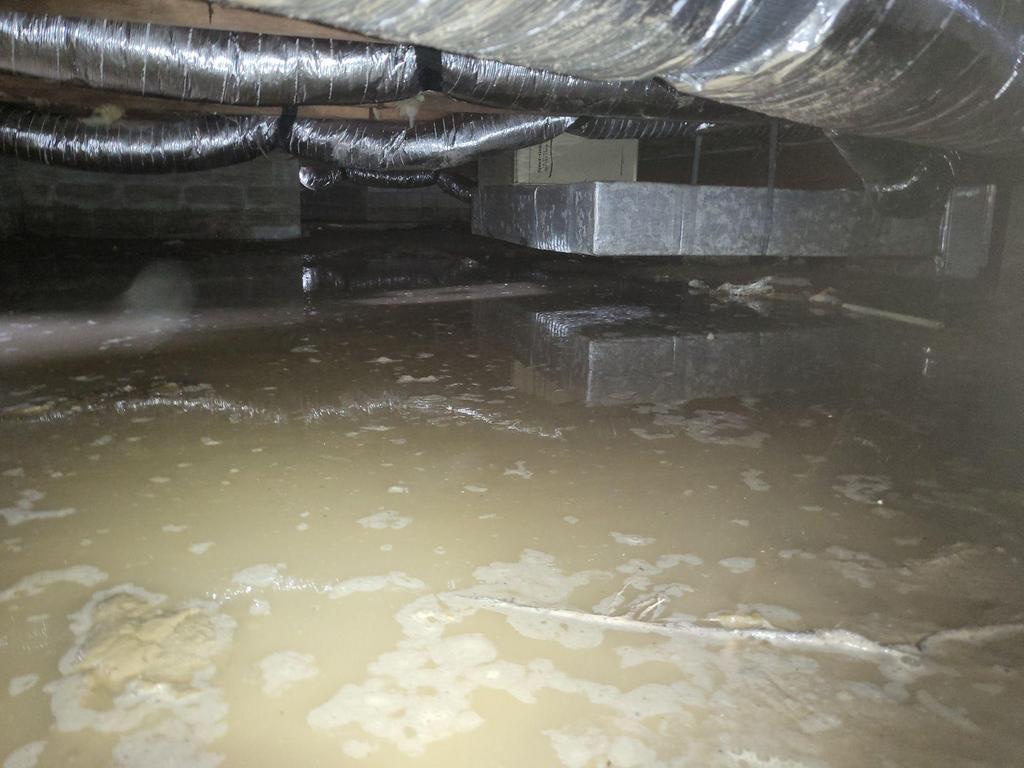
What If You Have Standing Water?
Standing water is a serious issue that impacts:
- humidity
- HVAC performance
- indoor air quality
- structural integrity
Solutions include:
- French drains
- sump pumps
- downspout extensions
- regrading
- gutter improvements
But beware:
A sump pump alone will NOT solve standing water.
It may prevent flooding, but it does not remove groundwater intrusion from outside – only a french drain can do that.
Final Thoughts: Control Humidity, Protect Your Home
If you want to solve crawlspace problems once and for all, you must control the sources of moisture – both water and humidity.
That means:
✅ Vapor barrier
✅ Sealed vents
✅ Closed-cell spray foam
✅ A high-quality dehumidifier
…and in some cases,
✅ Drainage and sump systems
These upgrades protect:
your home, your health, your energy bills, your indoor air quality, your investment
Even if you don’t move forward with FLC Energy, always use a contractor able to provide references, reviews, proof of insurance and in Maryland, an MHIC License.
Ready to Fix Your Crawlspace for Good?
If you’re ready to control humidity and protect your home:
